
2.14.2012

Lemmings
Basic Facts

Length: 3 to 6 inches
Color: Thick gray or brown, white during the winter
Location: North America, Asia, Europe, Alaska
Food: They mostly eat plants such as mosses, grasses, herbs, shoots, and lichen. They have sharp teeth that allows them to gnaw through tangle of roots, mosses, and soil.
Lifespan: Live less than 2 years, they can have 3 to 7 babies
Enemies: Foxes, Weasels, Hawks, Owls, Gyrfalcon, and Wolves

2.10.2012
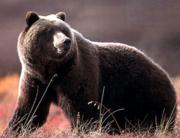
Grizzly Bear

Basic Facts
Size: They can weigh up to 704 lbs, be over 8 feet in length, and stand 3 1/2 feet high at the shoulders.
Location: North America, Europe, Asia
Color: Most are brown, black, or blond
Lifespan: 25 years
Habitat: make dens under rocks, in hollow trees, in caves
Enemies: None
Grizzly bears have amazing physical strength and are surprisingly fast over short distances. They are very aggressive and have no trouble driving away predators like wolves and mountain lions. The grizzly also has a great sense of smell.
|
The grizzly has a heavy, stout body, a big head, and short tail.
It has a distinctive hump between its shoulder blades.

Arctic Fox

Basic Facts
Length: 21 – 22 inch
Weight: 8.75 lbs.
Social Unit: Group
Location: N. Canada, Alaska, Greenland,
N. Europe, N. Asia
Status: Common

The Arctic fox comes in two sort of shades, one being white-phase and the other being blue-phase, distinguishing the kind of color they are during the winter.
The pure white helps to camouflage the fox in the snow and ice to protect from predators and enhance their
ability to sneak up on prey. These white foxes mainly reside in places that are
open, treeless plains and grassy hillocks. Foxes of the blue-phase are often
found in coastal regions and habitats near shrubbery. During the winter, these
foxes are pale gray-brown with tinges of blue.

During the summer months, the coat of an Arctic fox changes quite dramatically. It is now half as thick, and the color changes as well. For the white-phase fox, it becomes a gray-brown, while the blue-phase fox become a darker brown color.
Works Cited
"Tundra Climate." Blue Planet Biomes. Web. 13
Feb. 2012. <http://www.blueplanetbiomes.org/tundra_climate_page.htm>.
"9(k) Characteristics of
the Earth's Terrestrial Biomes." Geography
: Physical Geography. Web. 15 Feb. 2012.
<http://www.physicalgeography.net/fundamentals/9k.html>.
"Arctic and Alpine Tundra
Soil and Land Formation." Biomes.
ThinkQuest. Web. 15 Feb. 2012.
<http://library.thinkquest.org/C0113340/main.php?section=biomes&topic=tundra&subtopic=soilland>.
Snowy Owl. Youtube.com.
Web. 15 Feb. 2012. <http://www.youtube.com/watch?feature=player_embedded&v=jN2Hpd_W9g8>.
"Tundra Animals : Artic
Fox." Tundra Animals
Plants. Web. 14 Feb. 2012.
<http://tundra-animals-plants.blogspot.com/2011/05/tundra-animals-artic-fox.html>.
"Tundra Animals : Snowy
Owl." Tundra Animals
Plants. Web. 14 Feb. 2012.
<http://tundra-animals-plants.blogspot.com/2011/05/tundra-animals-snowy-owl.html>.
Subscribe to:
Posts (Atom)